Grammarly Accessibility Program Assessment
Better accessibility starts with in-house expertise & leadership buy-in.
The Ask
During my initial 4-month embedded engagement as an accessible design consultant, Grammarly hired a new leader for their Design Foundations team. As she was getting up to speed and my engagement was winding down in November 2024, she asked me to create a report showing how Grammarly’s accessibility program and product quality measured up against other organizations.
The team was also hoping for some materials they could use to justify expanded budgets and support for accessibility initiatives.
Eight weeks later, I rejoined the team for a second 6-month engagement. At the conclusion of that engagement in July 2025, I was asked to conduct a follow-up assessment to see how the program had evolved and where they should focus next.
The Solution
I developed a comprehensive evaluation framework that assessed accessibility maturity across four critical dimensions: Product, Process, Priority, and Participation. This proprietary framework balanced both product accessibility and organizational strength—an approach existing maturity models lacked.
The framework was applied twice: a baseline assessment in November 2024 and a follow-up evaluation in July 2025. The comparison revealed measurable improvements in areas where Grammarly had invested, while highlighting persistent gaps that continued to create business risk. Each assessment included a strategic roadmap with prioritized recommendations for continued growth.
The Approach
Creating a framework
While several accessibility maturity models exist, none felt appropriately balanced between product accessibility and organizational strength. Many focused heavily on technical compliance, neglecting the cultural, process, and leadership factors that enable sustainable accessibility programs. Others emphasized organizational maturity but didn’t adequately assess the product’s actual quality and accessibility.
To create a more holistic assessment, I developed a proprietary framework informed by existing models but designed to evaluate both what an organization produces and how it produces its product.
Research Methods
The framework was developed and validated through multiple research methods:
- Stakeholder Interviews – Conducted interviews with accessibility team members, Design Foundations team, product managers, and cross-functional partners to understand roles, responsibilities, challenges, and perspectives across the organization.
- Team Observation – Embedded with teams for extended periods, participating in design critiques, share-outs, planning conversations, and all-hands meetings to understand both formal processes and informal culture.
- Historical Documentation – Reviewed existing processes, accessibility artifacts, ACR reports, and design documentation to understand the evolution of accessibility practices and identify patterns in how issues were caught and resolved.
Building the assessment

Creating Criteria
The framework evaluates organizations across four critical dimensions using qualitative assessments converted into a quantitative score that can be plotted on a graph.
Product – The current state of accessibility in the live product against WCAG standards, including visual design compliance, code quality, backlog health, ACR availability, and QA processes.
Process – How product innovation, design, and development processes incorporate accessibility, including documentation quality, standardization, and evaluation cadence.
Priority – How leadership prioritizes accessibility through executive support, team resourcing, backlog management, and internal requirements.
Participation – How cross-functional teams engage with accessibility through engineering practices, design system adoption, education, awareness, and celebration of wins.
Each dimension contains multiple sub-criteria, all scored against industry benchmarks. This quantitative approach allows for objective comparison over time while the qualitative research provides context for why scores are what they are.
Identifying Stages
The assessment then assigns the placement of the organization along a maturity timeline that’s broken into one of three stages.
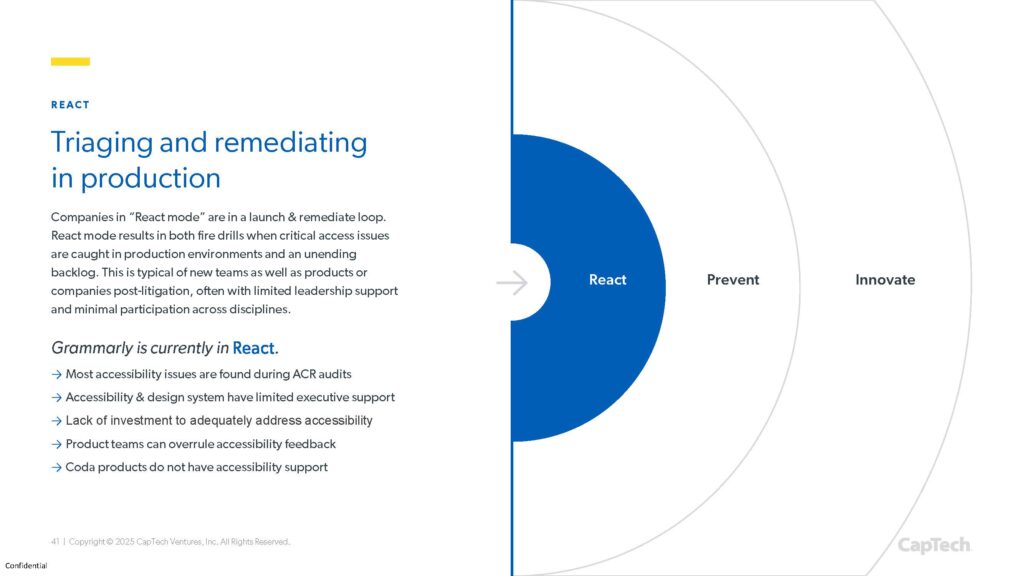
React – New teams or products with extremely limited resources. Most companies fall into this stage – they’ve added accessibility teams or audits to their process but there is limited internal support for lasting change. There’s often an audit & remediate loop.
Prevent – This is the minimum maturity for a healthy accessibility team. These teams consider accessibility at all stages of the design innovation cycle.
Innovate – In this stage, the whole organization has bought into the importance of accessibility and the mindset has shifted from an obligation to an opportunity for innovation.
Initial Findings & Follow-Ups
Findings
The baseline assessment revealed an organization with strong accessibility intentions but inconsistent execution. Grammarly had the foundation of an accessibility program—a dedicated accessibility lead, an accessible design system, and documentation of processes—but struggled to implement it at scale.
Key observations:
- Most accessibility issues were caught during ACR audits rather than prevented during development
- The accessibility team (1 person) couldn’t adequately support the volume of work across Grammarly’s product suite
Maturity Stage: React – The organization was primarily in a “launch and remediate” cycle, addressing accessibility issues after they reached production rather than preventing them earlier in the process.
The baseline assessment included a prioritized roadmap with actionable recommendations spanning organizational structure, team capacity, process implementation, and cultural change. These recommendations were designed to help Grammarly transition from reactive remediation to proactive prevention.
Actions & Implementation
Grammarly took on the feedback and implemented several actions, including adding staff, increasing consulting hours, and utilizing the accessibility lead’s skills in partnership for developing a new feature.
Between November 2024 and July 2025, Grammarly began implementing recommendations from the baseline assessment:
Team Growth – Added an accessibility engineer to focus on backlog remediation and provide technical support to development teams.
Process Improvements – Implemented new accessibility checkpoints in the product development process and created a “beta” flag system to communicate feature accessibility status to users.
Tooling & Efficiency – Created a database-driven template for accessibility audits, reducing audit completion time by 40%. Built Jira integration for real-time visibility into accessibility issue status. The process was built to be ready for an AI tool enablement.
Design System Adoption – Secured approval to expand the design system across all Grammarly products, providing an accessible foundation for future development.
Re-assessment & Updated Actions
Measuring Progress
Six months after the baseline assessment, I returned to Grammarly as a consultant, knowing that I’d also evaluate how the program had evolved at the end of the assignment. Using the same framework and methodology ensured an apples-to-apples comparison.
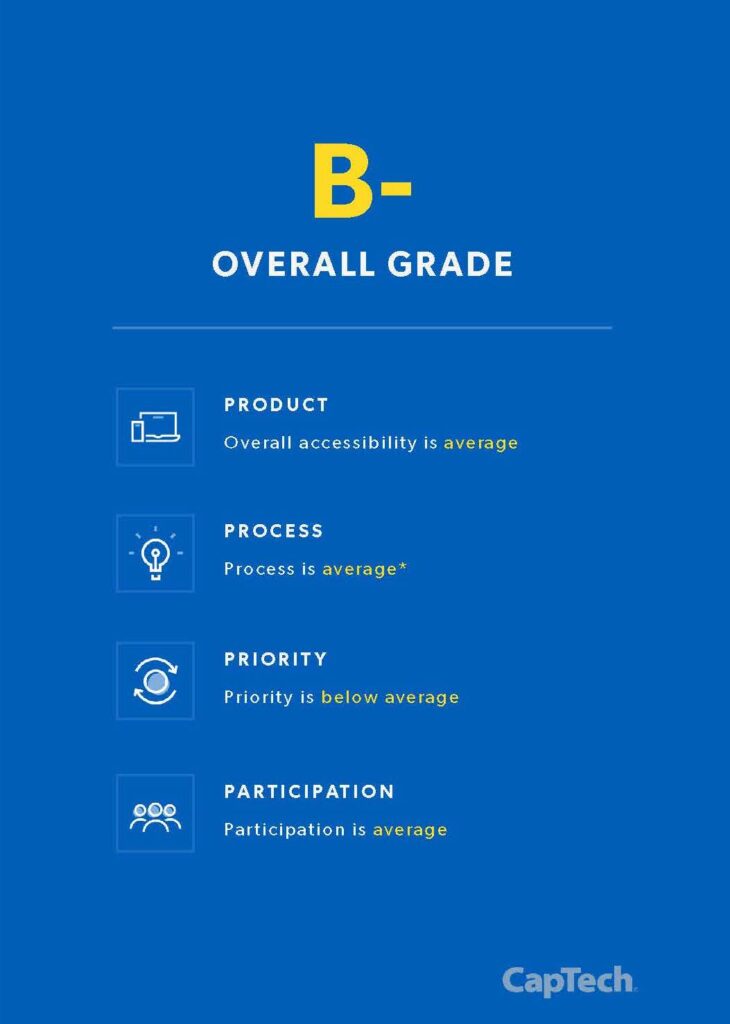
Overall Grade: B- (up from the baseline assessment of C)
The assessment revealed a pattern: areas where Grammarly had invested showed clear improvement, while areas that lacked investment continued to create risk. The organization had made progress but remained in the “React” stage of maturity—still primarily catching and fixing issues after launch rather than preventing them during development.
Findings
The follow-up assessment showed meaningful improvements across all four dimensions:
Product – New features following updated processes launched with fewer accessibility issues. The accessibility engineer had remediated hundreds of backlog items. However, most issues were still being caught during audits rather than prevented during development.
Process – Teams that engaged with the accessibility team early showed positive outcomes. Documentation was strong and processes were well-defined, but universal rollout and accountability remained challenges.
Priority – This remained the lowest-scoring dimension. While the team had grown from 1 to 2 people and had gained some leadership visibility, there was still no executive sponsor and the team size remained insufficient for the product portfolio.
Participation – Awareness had increased significantly with leadership presentations and internal recognition. However, engineering teams still lacked accessibility expertise, and education opportunities were limited by team capacity.
Added value
The two-assessment approach proved the value of the framework by providing:
- Objective measurement of program health against industry benchmarks
- Evidence of progress in areas where Grammarly invested resources
- Clear identification of gaps that continued to create business and compliance risk
- Data-driven prioritization for where to invest next
Outcomes
Business Impact
The assessments helped leadership understand accessibility’s bottom-line impact:
- Protected several million dollars in annual contracts requiring WCAG compliance
- Reduced risk for potential Apple contract negotiations
- Mitigated legal and reputational risk from international accessibility laws (European Accessibility Act effective June 2025)
- Opened opportunities with educational institutions requiring robust accessibility
Measurable Improvements
Between assessments, Grammarly achieved concrete results:
- 40% reduction in audit completion time through process automation
- Hundreds of accessibility issues remediated from the backlog
- Fewer accessibility issues in new features that followed updated processes
- Real-time visibility into accessibility status through Jira integration
- Increased organizational awareness through leadership presentations and recognition
Project Details
Role
Inclusive Design Manager / Embeded Accessible Design Consultant
Client
Grammarly
Process & Methodologies
Stakeholder interviews
User interviews
Accessibility Conformance Reports